
Sand-grade carbonate
Aragonite sand.
Natural oolitic aragonite of Bahamian marine origin, washed, screened and dried, then classified into sand-range grades from one gradation.
The material
One deposit, one gradation, screened into grades.
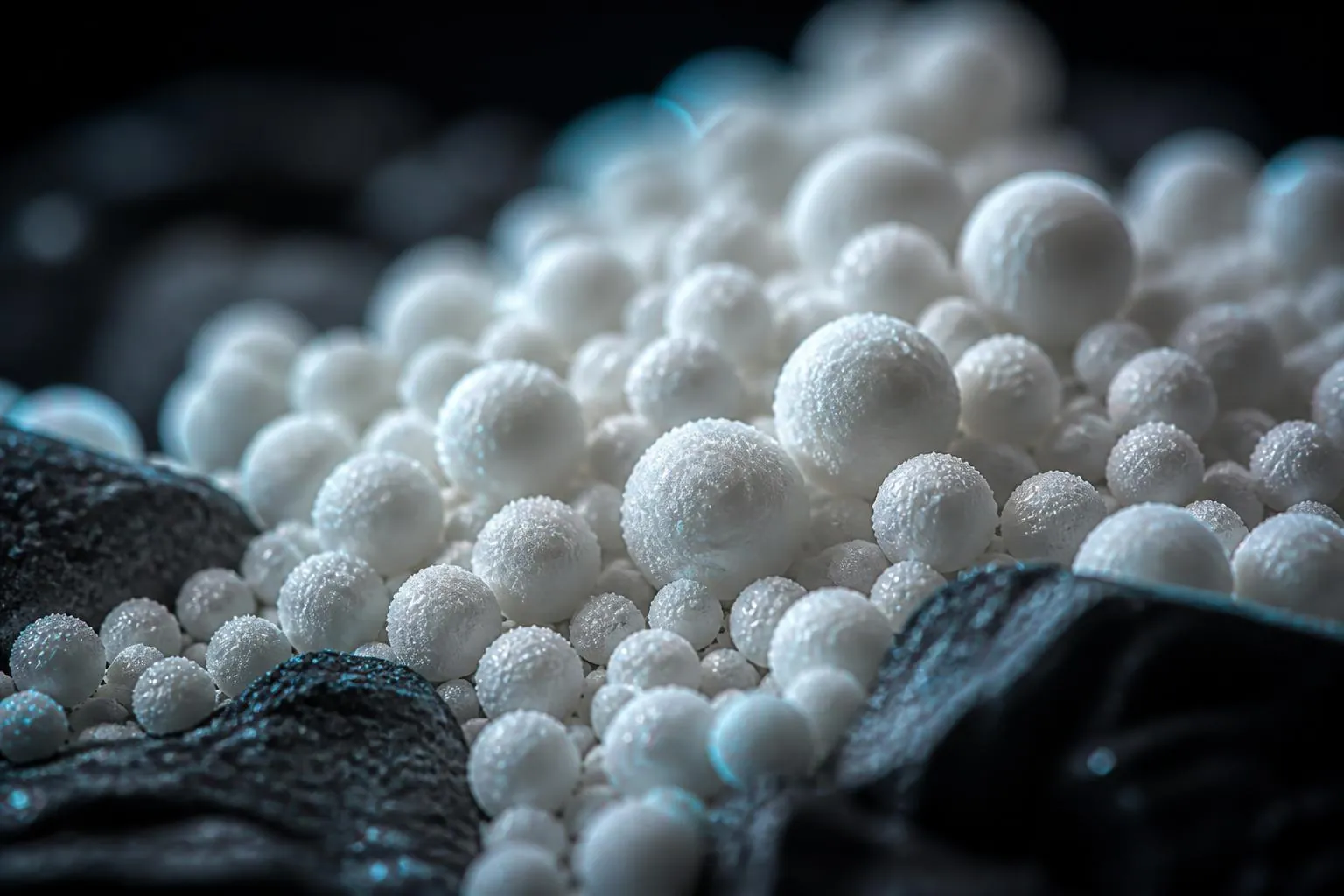
“Aragonite sand” is the common name for sand-sized grains of aragonite — the orthorhombic polymorph of calcium carbonate. AragoCor material is naturally precipitated oolitic aragonite, mechanically collected in The Bahamas, then washed, screened and dried. It is not calcined, not milled from quarried rock, and not a manufactured carbonate.
- Composition
- 96.17% CaCO3
- Elemental calcium
- 38.51%
- Sizing range
- 20–325 mesh
- Mineral form
- Oolitic aragonite
Representative analysis, ASTM C 25, Bowser-Morner report 124914A.
Same report and method.
Across grades, screened from the natural gradation below.
Orthorhombic calcium carbonate, CAS 1317-65-3.
Physical properties
What the grain actually is.
Specific gravity 2.93
Representative analysis. Particle density, not a bulk or bed density — bulk density depends on the delivered cut, moisture and how the material is placed, so it is confirmed against the grade rather than published as one figure.
Mohs hardness 3.5–4
Published range. Relevant to abrasion, attrition in handling and wear on conveying equipment.
Surface area > 1.7 m2/g
Representative analysis, Keck Lab. Oolitic grains are concentrically layered rather than solid, which is why the figure is high for a sand-sized carbonate.
Moisture as received 5–10%
Published range. Specify a drier delivery if the process requires one, and it will be confirmed against the grade and volume.
Natural gradation
Screen the deposit, do not assume the cut.
Every classified grade is screened from this one natural gradation. It is the honest answer to “how coarse can you go”: the coarse fractions exist, but they are a small share of what the deposit contains, and a large standing order at the top of the range is a different conversation from one in the middle.
| U.S. mesh | Nominal opening | Percent retained | Status |
|---|---|---|---|
| 4 | 4.75 mm | 0–1 | Published range |
| 8 | 2.36 mm | 1–4 | Published range |
| 16 | 1.18 mm | 3–11 | Published range |
| 30 | 600 µm | 10–26 | Published range |
| 50 | 300 µm | 40–67 | Published range |
| 100 | 150 µm | 80–98 | Published range |
| 140 | 106 µm | 93–99 | Published range |
| 200 | 75 µm | 99–100 | Published range |
Nominal openings are standard U.S. sieve equivalents, given for reference. Lot values are confirmed by certificate of analysis.
Sand-range grades
Two cuts sit in the sand range; a third is classified to order.
AG-CAL · 0.2–0.5 mm
The agricultural sand grade. Soil calcium and pH programs, turf top-dressing and feed-additive use. Published range.
WT-CAL · 1–3 mm
The coarsest classified grade. Process-water remineralization, pond preparation, alkalinity management and carbonate aggregate. Published range.
PL-CAL · to specification
Classified to a customer specification across the 20–325 mesh range. Send the target distribution and it is quoted against the gradation.
GL-CAL · below 0.1 mm
Below the sand range, listed for completeness: a high-purity glass-batch carbonate source rather than a substrate or media grade.
Full sizing, applications and data sheets are on the products page.
Where it is used
The application decides the cut.
Aquarium and aquaculture
Substrate, graded media and a carbonate source in aquatic systems. Sizing governs settling, flow, cleaning and equipment interaction.
Water treatment
Remineralization and pH adjustment media, where bed sizing and contact time drive the design.
Turf and horticulture
Top-dressing and root-zone amendment, where particle distribution has to match the existing profile.
Agriculture and feed
Soil calcium and pH programs, and calcium-bearing mineral input to feed formulations.
What to send
Four inputs and the grade is matched to them.
Target particle distribution
Not just a nominal size. The distribution, and any limit on fines or oversize, is what the screening plan is set against.
Application and operating system
What the material sits in, and the chemistry, flow and equipment around it. Regulated uses are established by the applicable jurisdiction, not by composition.
Volume and cadence
Trial quantity, annual volume and whether it is a standing order. The coarse end of the gradation is supply-limited, so cadence matters more there.
Format and destination
Dry bulk by vessel or bulk trailer, super sacks up to 3,000 lb, or bagged from 1 lb. Distribution is from Stockton, California; the format is confirmed with the order.
Questions
Frequently asked questions.
What is aragonite sand?
Aragonite sand is the common name for sand-sized grains of aragonite, the orthorhombic polymorph of calcium carbonate. AragoCor material is natural oolitic aragonite of Bahamian marine origin, mechanically collected, washed, screened and dried, at 96.17% CaCO3 by ASTM C 25.
What grain sizes are available?
Classified grades are screened from one natural gradation spanning 20 to 325 U.S. mesh. AG-CAL is 0.2–0.5 mm, WT-CAL is 1–3 mm, GL-CAL is below 0.1 mm, and PL-CAL is classified to a customer specification.
Is aragonite sand the same as calcite sand?
Both are calcium carbonate, but they are different crystal systems. Aragonite is orthorhombic and here of marine origin; calcite sands are quarried. Any dissolution or buffering comparison has to be made on the delivered particle size by a method relevant to the application rather than asserted from the mineral name.
Is it OMRI Listed?
Yes. The crop fertilizer listing is avw-23214 and the livestock feed-material listing is avw-23215. OMRI operates a listing program rather than a certification, and whether a specific operation may use a listed input rests with its certifier.
How coarse can the sand be supplied?
The natural gradation retains 0–1% on a 4 mesh screen and 1–4% on an 8 mesh screen, so the coarse fraction is a small part of the deposit. WT-CAL at 1–3 mm is the coarsest classified grade. Send the target distribution and the volume and the available cut will be confirmed against it.
How is it packaged?
Dry bulk by vessel or bulk trailer, super sacks up to 3,000 lb, and bagged from 1 lb, distributed from Stockton, California. Packaging is confirmed with the order; send the format and volume required.
Keep reading
Where to go next.
Send a target distribution and a volume.
Give the application, the particle distribution you need, the annual volume and the destination, and AragoCor will match a grade against the gradation and quote it.