
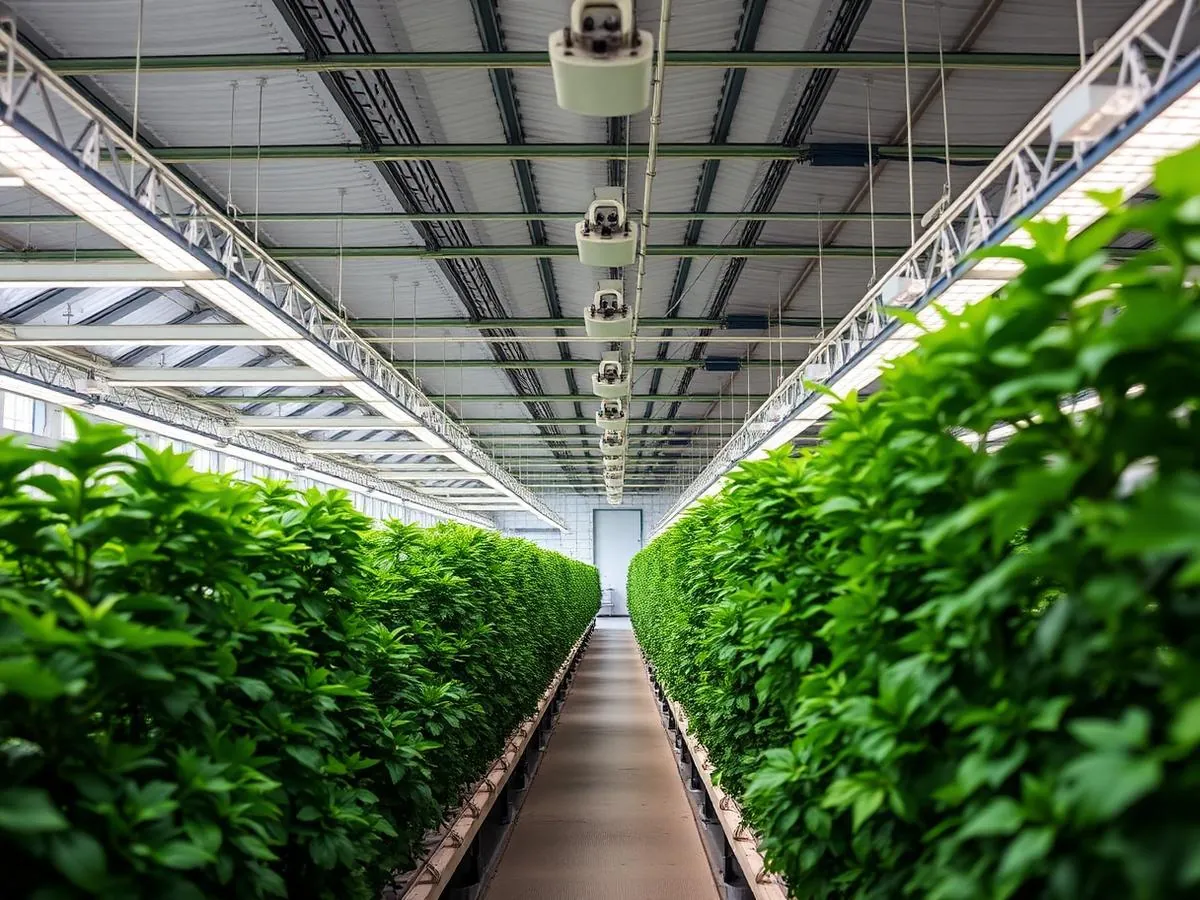
Growing media
Calcium carbonate for potting soil.
A natural marine carbonate for pH adjustment and calcium supply in potting mixes, nursery substrates and blended container media, at a rate set by testing the complete substrate.
Peat needs carbonate. Other components vary.
Where carbonate is needed, it supplies alkalinity that lifts substrate pH and contributes calcium to the fertility program.
- Peat-based mixes often require carbonate to raise pH.
- Coir commonly starts much closer to neutral and does not carry peat's lime requirement.
- Bark and composted components vary again.
Test the complete substrate before selecting a carbonate grade or rate. Calcium contribution, irrigation-water alkalinity, crop needs and the fertilizer program should be considered together.
- Composition
- 96.17% CaCO3Representative analysis, ASTM C 25, Bowser-Morner report 124914A.
- Elemental calcium
- 38.51%Representative analysis, same report and method; the basis for calcium contribution within the complete fertility program.
- AG-CAL sizing
- 0.2–0.5 mmPublished range for the grade used in media programs; custom classification to customer specification across 20–325 U.S. mesh.
- OMRI listing
- avw-23214Crop fertilizer listing, for growers running qualifying organic programs.
What decides the rate
Four inputs, and none of them is the bag label.
A media rate is calculated from the substrate's own chemistry and the crop's requirements. The same product goes in at different rates for different mixes.
Starting substrate
Document the substrate pH, lime requirement, electrical conductivity and exchange capacity before calculating anything. Peat, coir, bark and composted components each behave differently.
Target pH window
Crop, cultivar and production cycle set the window. Container volume and crop length determine how long the substrate has to hold it.
Irrigation water
Water alkalinity pushes substrate pH over the crop cycle in its own right, so it belongs in the calculation alongside the carbonate rate.
Fertilizer program
Acidic and basic residual fertilizers move substrate pH in opposite directions. Evaluate the carbonate rate within the complete fertility program, not on its own.
Blending into production
Uniformity is a particle-size question.
Particle distribution
Sizing governs reaction timing and blend uniformity. Finer fractions react sooner and disperse more evenly; coarser fractions persist longer in the container.
AG-CAL at 0.2–0.5 mm sits in the range used for media blending; other distributions are quoted as custom classification to customer specification across 20–325 U.S. mesh.
Mixing sequence and dispersion
Addition point, mixer type, batch size and mixing time determine whether the carbonate is evenly distributed or concentrated in pockets that give inconsistent pot-to-pot results.
Moisture and segregation
Substrate moisture at mixing affects dispersion, dust and the tendency of a dry mineral to segregate during handling, storage and filling.
Batch consistency
Grade specifications and analytical documentation define the chemistry and sizing behind each supplied batch, which is what makes a media recipe repeatable.
Carbonate choices in a container mix.
Dolomitic limestone is the default in many media recipes because it carries magnesium as well as calcium. Whether that is an advantage depends on what the rest of the program already supplies.
| Decision factor | Oolitic aragonite | Calcitic limestone | Dolomitic limestone |
|---|---|---|---|
| Chemistry | Natural marine CaCO3, aragonite polymorph | Calcitic CaCO3, calcite polymorph | Calcium magnesium carbonate |
| pH contribution | Supplies alkalinity; condition-dependent | Supplies alkalinity; condition-dependent | Supplies alkalinity; condition-dependent |
| Calcium basis | 38.51% elemental calcium | Grade-dependent | Grade-dependent |
| Magnesium | Not a magnesium source | Not a magnesium source | Supplies magnesium as well as calcium |
| Selection control | Substrate test, grade data and a crop trial | Supplier data and a crop trial | Substrate magnesium status and a crop trial |
Bench blend before the production mixer.
Bench blend
Prepare representative small batches using the production substrate, irrigation water and fertilizer program.
Track
Measure substrate pH and electrical conductivity at defined intervals across the production cycle, alongside crop response.
Scale
Move the established rate and mixing sequence into the production blending program.
Frequently asked questions.
Why is calcium carbonate added to potting soil?
Peat-based media start well below the pH window most container crops want and usually need carbonate to raise it. Coir commonly starts much closer to neutral, and bark and composted components vary, so whether a mix needs carbonate, and how much, is set by testing the complete substrate.
Where it goes in, calcium carbonate supplies alkalinity that raises substrate pH and contributes calcium to the fertility program.
How much should be added to a mix?
The rate comes from the substrate's lime requirement, the crop's target pH window, irrigation-water alkalinity and the fertilizer program — not from a single recommended figure. Bench-blend representative batches with your own substrate and water, then measure pH and electrical conductivity across the production cycle before scaling.
Which grade suits a container mix?
AG-CAL at 0.2–0.5 mm is the grade used in media programs. Where a recipe calls for a different reaction timing or blend uniformity, custom classification to customer specification is offered across 20–325 U.S. mesh.
Does it replace dolomitic lime?
It replaces the calcium and alkalinity that dolomitic lime supplies, but not the magnesium. If the substrate and fertility program depend on dolomitic limestone for magnesium, that magnesium has to come from somewhere else in the program.
Is it OMRI Listed for growing media?
The crop fertilizer listing is avw-23214. OMRI operates a listing program rather than a certification, and whether a specific operation may use a listed input rests with your certifier.
Will it change the electrical conductivity of the mix?
Carbonates are only slightly soluble in water, so the direct contribution to EC is small next to fertilizer salts. Measure pH and EC together through the crop cycle regardless — substrate pH movement changes nutrient availability, and that is what shows up in the crop.
Where to go next.
Discuss a media, crop and blending program.
Send the substrate analysis, crop, target pH window, batch volume and destination, and AragoCor will match a grade and quote against it.