
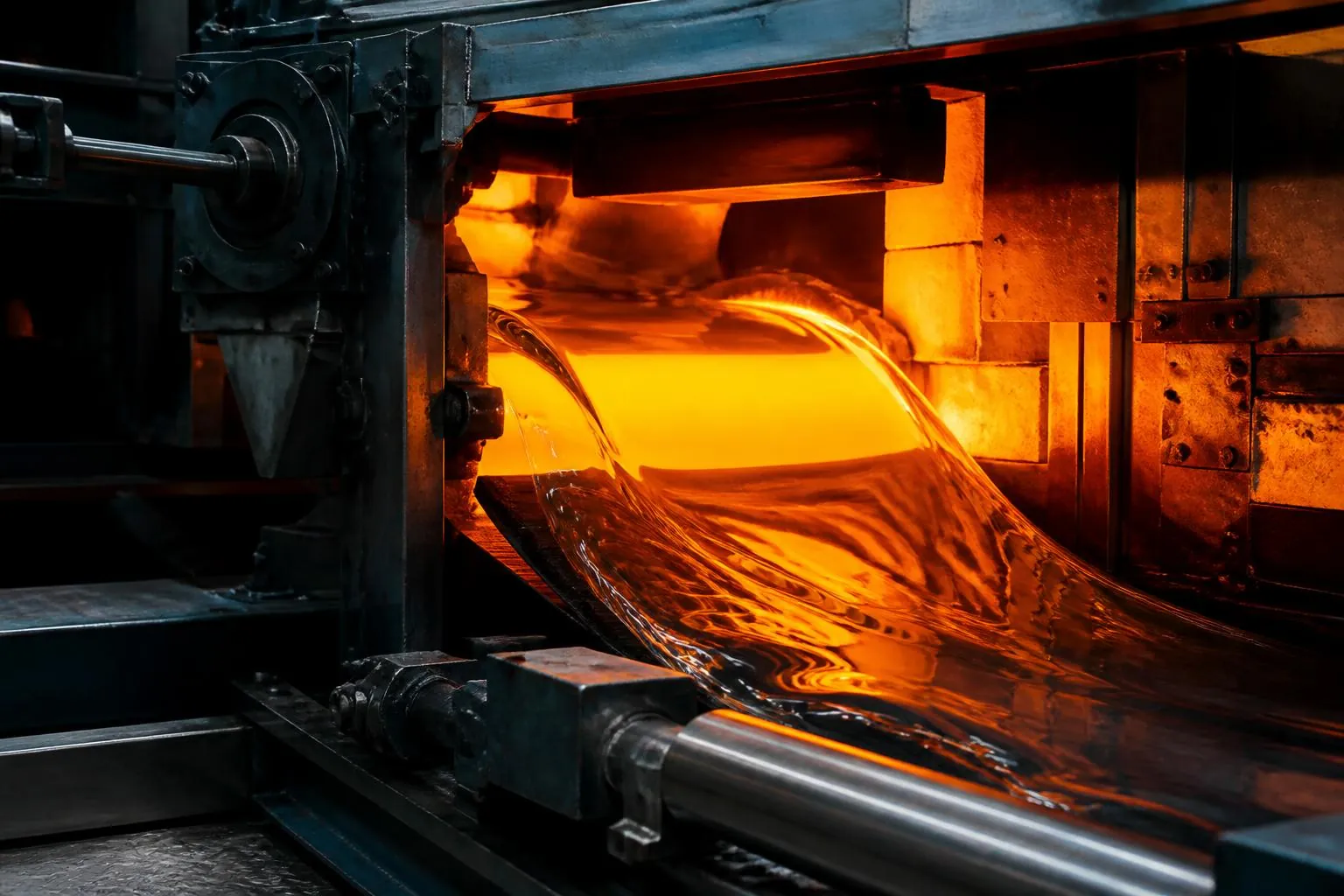
Glass batch
Calcium carbonate for glass manufacturing.
Oolitic aragonite as the calcium-oxide source in container, flat, solar, fiberglass and specialty glass batches.
Calcium carbonate is where the batch gets its CaO.
Calcium carbonate is a standard soda-lime raw material — one of the three principal batch ingredients alongside silica sand and soda ash.
- On heating, it decomposes and releases CO2, leaving calcium oxide in the melt.
- In the melt, CaO acts as the stabilizer that gives the finished glass its chemical durability.
- Composition
- 96.17% CaCO3Representative analysis, ASTM C 25, Bowser-Morner report 124914A.
- Elemental calcium
- 38.51%Representative analysis, same report and method; the basis for CaO contribution calculations.
- GL-CAL sizing
- Below 0.1 mmPublished range for the glass batch feed grade, sized for batch mixing and handling.
- Specific gravity
- 2.93Representative analysis; material density for batch weighing, conveying and storage design.
The specifications a glass buyer checks — iron first.
Iron oxide is the impurity of greatest consequence in glass raw materials because it colors the melt, and the effect is most visible in flint, optical and solar glass.
Iron content (Fe2O3)
Iron drives coloration, so the trace-metal profile matters more than the headline carbonate assay. AragoCor provides documented trace-metal analysis for the supplied glass grade against your batch limits.
Purity and carbonate assay
Composition is 96.17% CaCO3, representative analysis by ASTM C 25. The carbonate assay sets the CaO contribution the batch calculation works from.
Particle distribution
GL-CAL is sized below 0.1 mm. Sizing influences batch mixing, segregation, dusting, carry-over and the rate at which the carbonate decomposes in the melt.
Moisture and batch consistency
Moisture and delivered sizing govern flow, weighing accuracy and batch-to-batch repeatability. Grade specifications and analytical documentation organize all three.
Glass types
One carbonate feedstock, several batch requirements.
- Container glass — high-volume soda-lime production where carbonate consistency and handling behavior carry the cost.
- Flat glass — float lines where batch uniformity and trace chemistry meet tight optical requirements.
- Solar glass — low-iron requirements are the governing constraint, so the trace-metal analysis leads the evaluation.
- Fiberglass — batch chemistry and particle distribution are matched to the forming process and fiber specification.
- Specialty glass — each formulation sets its own chemistry, coloration and impurity limits.
Aragonite and calcite compared
Same formula, different mineral.
Limestone is composed principally of calcite. AragoCor supplies the aragonite polymorph of the same compound, and the differences below are the ones that reach the batch house.
| Property | Oolitic aragonite | Calcite / limestone | Why it matters |
|---|---|---|---|
| Crystal system | Orthorhombic | Trigonal / rhombohedral | Distinct lattice and physical properties |
| Density (g/cm3) | 2.93 | 2.71 | Different material density in weighing and conveying |
| Purity | 96.17% CaCO3 | Product-dependent | Sets the CaO contribution in the batch calculation |
| Particle morphology | Rounded, oolitic grains | Deposit- and milling-dependent | Grade-specific flow, packing and mixing behavior |
| Processing | Supplied without a calcination step | Deposit- and process-dependent | Source, processing and logistics differ |
From batch calculation to production melt.
Specify
Provide the glass type, batch formulation, cullet ratio and the impurity limits — iron above all — that the finished glass has to meet.
Analyze
Review the glass-grade chemistry, trace-metal analysis and particle distribution against those limits before any material moves.
Trial
Run the grade in a laboratory or production melt under the furnace design and batch conditions the material will actually see.
Frequently asked questions.
What does calcium carbonate do in a glass batch?
It supplies calcium oxide, one of the three principal soda-lime batch constituents alongside silica sand and soda ash. On heating the carbonate decomposes and releases CO2, leaving CaO in the melt, where it acts as a stabilizer that improves the chemical durability of the finished glass.
What is GL-CAL?
GL-CAL is the AragoCor glass batch feed grade: natural oolitic aragonite at 96.17% CaCO3, sized below 0.1 mm for batch mixing and handling.
Why does iron content matter so much in glass raw materials?
Iron oxide colors the melt. In flint, optical and solar glass that coloration is the limiting quality constraint, so raw materials are selected on their trace-metal profile rather than on carbonate assay alone. AragoCor provides documented trace-metal analysis for the supplied glass grade so it can be checked against the batch limits.
Is aragonite different from limestone in the batch?
Both are calcium carbonate, but they are different mineral polymorphs. Aragonite is orthorhombic with a density of 2.93 g/cm3; calcite is trigonal at 2.71 g/cm3. The oolitic morphology also gives rounded grains rather than milled angular particles, which affects flow and packing.
Batch behavior still reflects furnace design, cullet ratio, particle distribution and the complete formulation, so the comparison that decides material selection is a trial under your own conditions.
What documentation comes with a glass grade?
Grade specifications, analytical documentation including trace-metal analysis, and the safety data sheet. The GL-CAL data sheet (TDS-GL-001), the glass batch chemistry technical brief and the master technical data sheet are downloadable from the resources library.
Can a sample be supplied for a melt trial?
Yes. Send the glass type, batch formulation and impurity limits with the sample request and the grade will be matched to them.
Where to go next.
Request the glass-grade specification and trace-metal analysis.
Tell us the glass type, batch formulation and impurity limits, and AragoCor will provide the technical documentation for the glass grade, including trace-metal data.