
Industries / Glass Manufacturing
Aragonite for Glass Manufacturing.
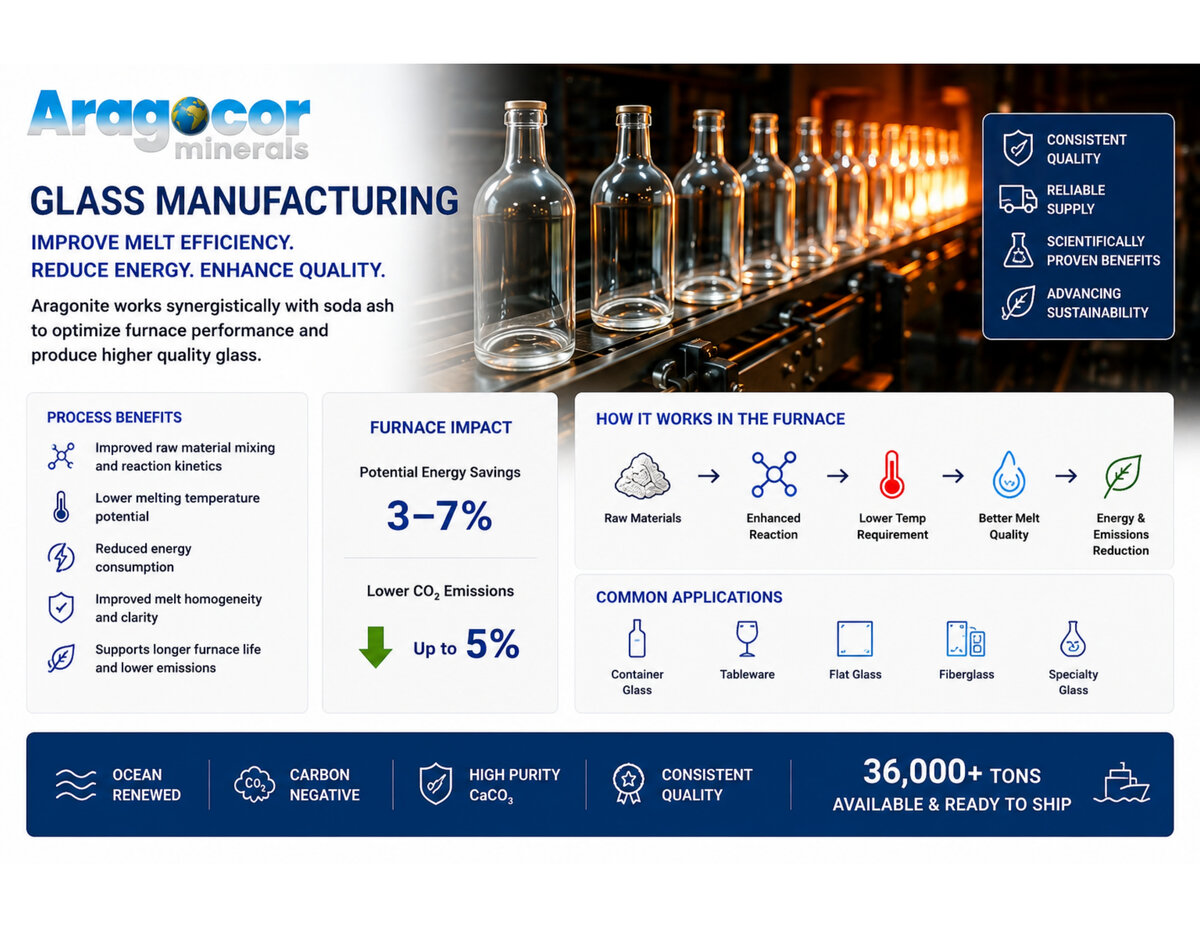
Natural oolitic aragonite as a calcium-oxide source for container, flat, solar, fiberglass and specialty glass batches.
Glass Manufacturing brochure
The role
What carbonate does in the glass batch.
Calcium carbonate is a standard raw material in the soda-lime glass batch — the source of calcium oxide (CaO), one of the three principal ingredients alongside silica sand and soda ash. On heating, the carbonate decomposes and releases CO2, leaving the oxide in the melt.
Source of calcium oxide
CaCO3 is a standard soda-lime batch ingredient — one of the three principal materials with silica sand and soda ash, supplying the batch’s calcium oxide.
Durability stabilizer
In the finished glass, CaO acts as a stabilizer that improves chemical durability — the reason calcium is a core batch constituent.
Decomposes in the melt
The carbonate decomposes on heating and releases CO2, leaving the calcium oxide behind in the melt.
Why aragonite
Distinct crystal structure and oolitic morphology.
Aragonite differs from calcite in crystal structure and oolitic morphology. Particle distribution, moisture, packing, decomposition behavior and trace chemistry all shape batch behavior.
Furnace design, cullet ratio and the complete batch formulation determine processing conditions.
What matters to a glass buyer
The specs that decide fit — iron first.
These documented properties define performance for a glass-grade carbonate.
Iron content (Fe2O3)
Iron oxide is the impurity of greatest consequence in glass raw materials because it causes coloration, particularly in clear/flint, optical and solar glass. AragoCor provides documented trace-metal analysis for the supplied glass grade.
Purity & particle sizing
High purity and controlled particle sizing support glass-batch performance. Composition is 96.17% CaCO3, and GL-CAL is sized below 0.1 mm.
Batch consistency
Product specifications and analytical documentation organize chemistry, sizing and moisture for repeatable batch preparation.
Application focus
High-purity carbonate for glass-batch design.
Complete chemistry. CaCO3, trace-element controls, moisture and particle distribution work together in glass-grade selection.
Application-specific targets. Container, float, fiber, solar and specialty glass each set distinct chemistry and optical requirements.
Where to go next
Specify a grade for this application.
Request glass-grade specification and trace-metal analysis.
Tell us the glass type and batch formulation and we will provide the technical documentation, including trace-metal data.