
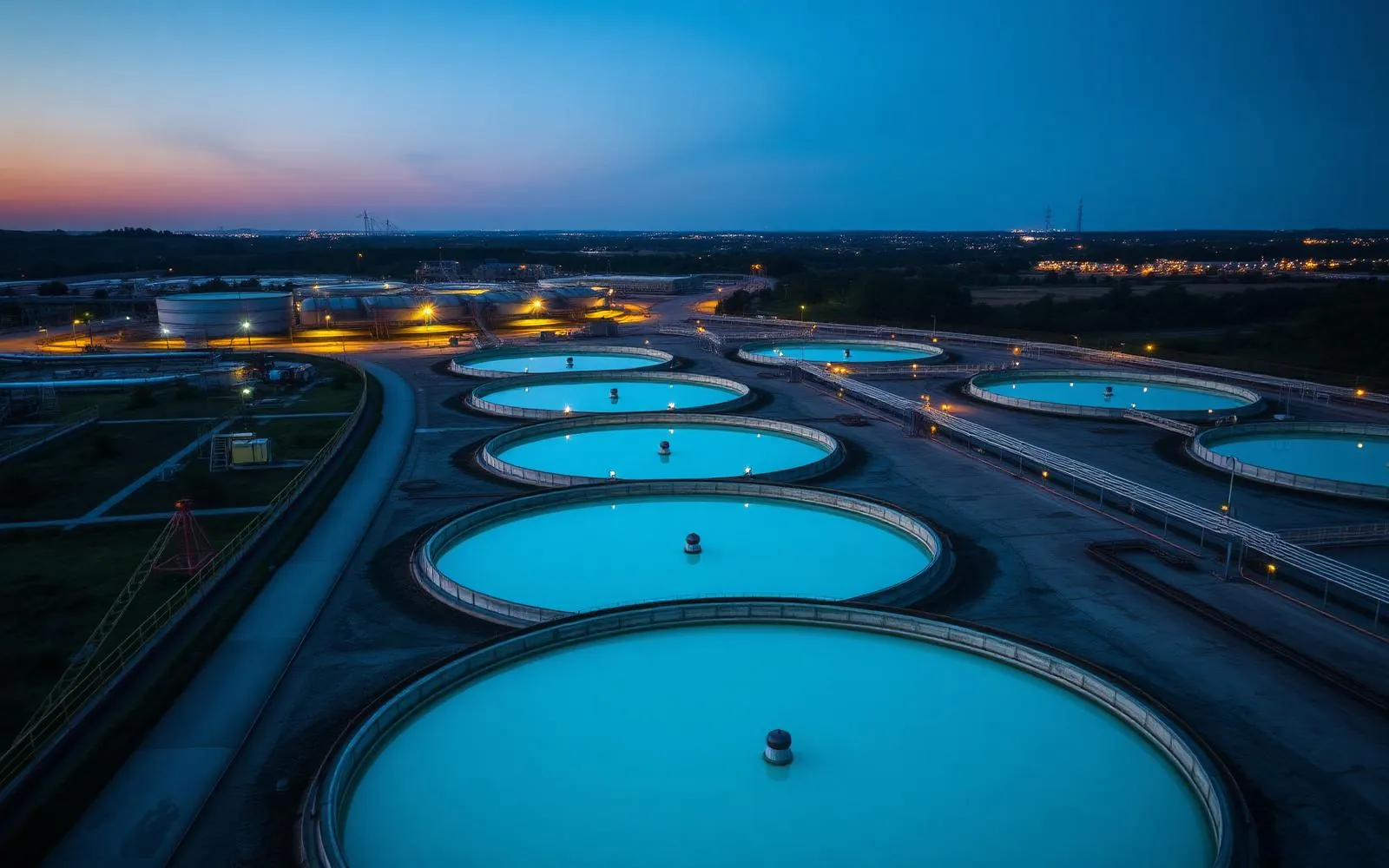
Calcium carbonate water treatment media.
Granular carbonate media for contactor remineralization, pH adjustment and filtration in engineered water systems, supplied as WT-CAL at 1–3 mm.
Water passes through the bed and dissolves it.
In a carbonate contactor, soft, desalinated or reverse-osmosis water passes through a granular bed and dissolves carbonate in a controlled way.
- What it raises. Calcium hardness, carbonate alkalinity and pH, toward the treatment targets.
- Other uses. The same chemistry is used for acid neutralization and, in some systems, for filtration.
- Composition
- 96.17% CaCO3Representative analysis, ASTM C 25, Bowser-Morner report 124914A.
- WT-CAL sizing
- 1–3 mmPublished range for the water-treatment media grade; custom classification to customer specification across 20–325 U.S. mesh.
- Specific gravity
- 2.93Representative analysis; material density, for bed loading and backwash calculations.
- Mineral form
- Oolitic aragoniteThe orthorhombic polymorph, with rounded, concentrically layered grains.
Design inputs
The bed is a system, not a product.
Whether a supplied grade fits is decided by the contactor, not by the mineral in isolation. These are the inputs that settle it.
Grain size and distribution
Grain size controls dissolution rate, head loss and backwash behavior, and it has to match the contactor design. WT-CAL is supplied at 1–3 mm, and technical documentation carries the particle-size data for the supplied grade.
Bed depth and contact time
Bed depth, flow rate and empty-bed contact time together determine how far the water moves toward the calcium, alkalinity and pH targets in a single pass.
Influent chemistry
Incoming pH, carbon dioxide, alkalinity and hardness govern how much carbonate dissolves. Two plants running the same media and bed reach different effluent chemistry on different source water.
Media consumption and replenishment
Dissolution is how the media works, so it is consumed. Consumption rate, top-up interval and backwash losses belong in the operating cost calculation from the start.
Faster dissolution is not automatically better.
- Aragonite can dissolve more readily than calcite under comparable conditions. In a contactor that behavior influences bed sizing, contact time and media consumption, and whether it helps depends on what the system is designed around.
- The trade runs both ways. More rapid dissolution can shorten the contact time needed to hit a target, or it can raise consumption and replenishment frequency. Influent chemistry, bed design and treatment targets decide which effect dominates.
Known limits
Regulated use is a separate question.
- AragoCor does not hold NSF/ANSI 61 or any potable-water contact certification.
- WT-CAL is not offered as a certified drinking-water contact medium.
- Suitability for drinking-water or another regulated application is not established by composition.
- Confirm the approvals and certifications your jurisdiction requires for the specific system and material.
Material comparison
Aragonite and calcite as contactor media.
| Decision factor | Oolitic aragonite | Calcite media | System control |
|---|---|---|---|
| Mineral form | Orthorhombic CaCO3 | Trigonal CaCO3 | Confirm the polymorph and source of the supplied media |
| Density (g/cm3) | 2.93 | 2.71 | Bed loading, expansion and backwash design |
| Dissolution | Higher under comparable acidic conditions | Lower under comparable acidic conditions | Contact time and consumption rate |
| Grain morphology | Rounded, oolitic grains | Deposit- and process-dependent | Head loss, packing and backwash behavior |
| Supplied sizing | WT-CAL at 1–3 mm | Product-dependent | Match the contactor's design particle range |
From water analysis to operating bed.
Define
Provide the influent analysis, design flow, treatment targets, contactor geometry and backwash regime.
Pilot
Run the supplied grade at representative flow and influent chemistry, and measure effluent calcium, alkalinity, pH and media consumption.
Operate
Set the top-up interval, backwash schedule and monitoring plan from the pilot result rather than from a general figure.
Frequently asked questions.
What is calcium carbonate water treatment media used for?
Chiefly for remineralizing desalinated and reverse-osmosis water, for pH adjustment and acid neutralization, and for filtration in systems designed around a granular carbonate bed. Water passing through the bed dissolves carbonate and gains calcium hardness, carbonate alkalinity and pH.
What grain size is supplied?
WT-CAL is supplied at 1–3 mm, a published range. Where a contactor is designed around a different distribution, custom classification to customer specification is offered across 20–325 U.S. mesh, and the particle-size data for the supplied grade is provided with the technical documentation.
How does a remineralization contactor work?
Soft or desalinated water, which is aggressive and low in alkalinity, is passed through a bed of granular carbonate. The carbonate dissolves in a controlled way and the water leaves with higher calcium hardness, carbonate alkalinity and pH. Bed depth, flow rate, contact time and influent chemistry set how far it moves in a single pass.
Is aragonite media better than calcite media?
It behaves differently rather than uniformly better. Aragonite can dissolve more readily than calcite under comparable conditions, which can shorten the contact time needed to reach a target — or raise media consumption. Which matters more depends on influent chemistry, bed design and treatment targets, so the comparison that counts is a pilot on your own water.
Is the media approved for drinking water?
No. AragoCor does not hold NSF/ANSI 61 or any potable-water contact certification, and WT-CAL is not offered as a certified drinking-water contact medium. Suitability for a regulated use is not established by composition alone; confirm the approvals and certifications your jurisdiction requires for the specific system before specifying any media for potable service.
What documentation is available?
Grade specifications, particle-size data, analytical documentation and the safety data sheet, all available through the contact form. The master technical data sheet is downloadable from the resources library.
Where to go next.
Discuss contactor design and media requirements.
Send the influent analysis, design flow, treatment targets, media volume and destination, and AragoCor will match a grade and quote against the system.
WT-CAL is not offered as a certified drinking-water contact medium; AragoCor holds no NSF/ANSI 61 or other potable-water contact certification.