

Industries / Water Treatment
Aragonite for Water Treatment.
A calcium carbonate medium for pH adjustment, remineralization and filtration in engineered water systems.
Water Remediation and Filtering brochure
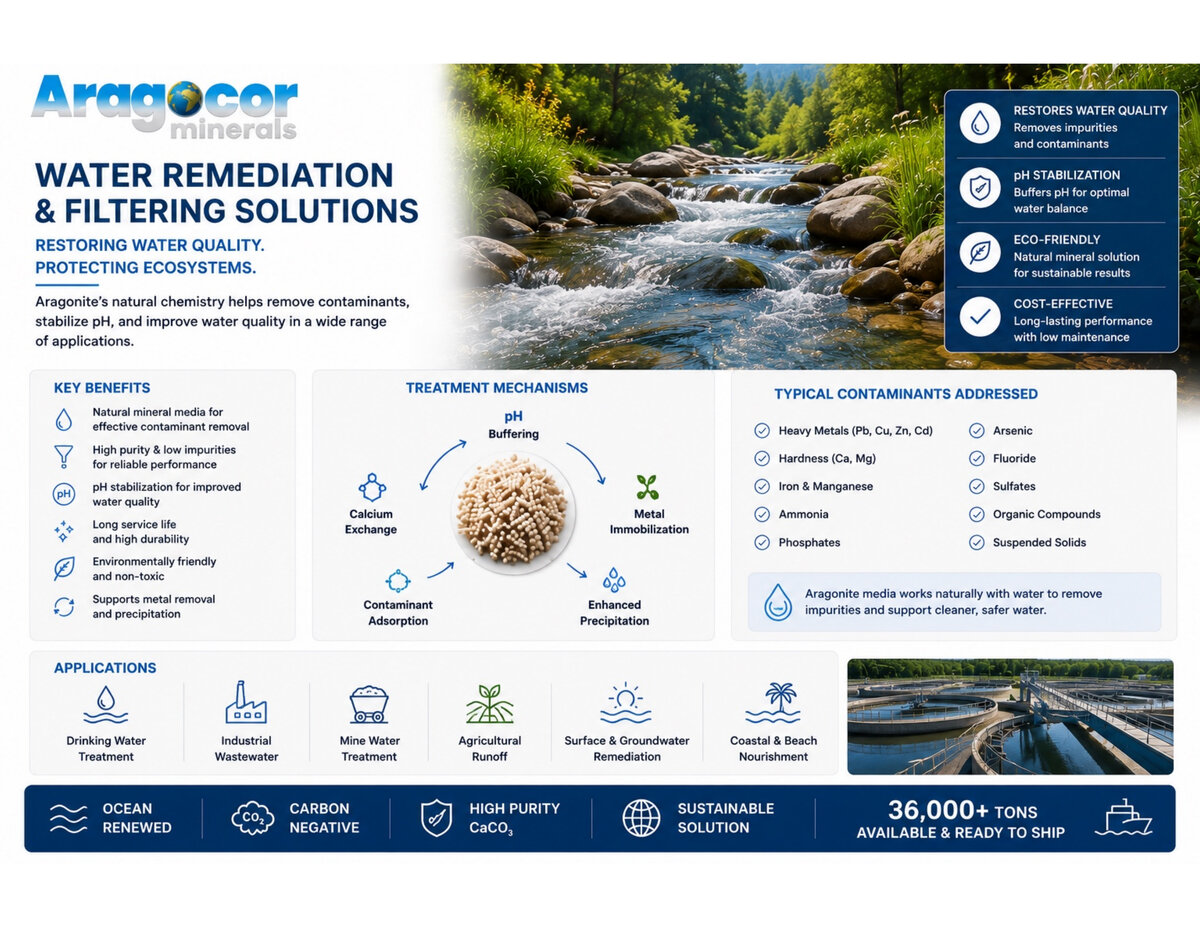
The role
What carbonate media do in water systems.
Calcium carbonate media are used for pH adjustment, acid neutralization, remineralization of desalinated or reverse-osmosis water, and filtration. In a carbonate contactor, water passes through a granular bed and dissolves carbonate, increasing calcium hardness, carbonate alkalinity and pH toward the treatment targets.
Contactor remineralization
Soft or desalinated water is passed through a carbonate bed that dissolves in a controlled way, restoring calcium hardness, carbonate alkalinity and pH.
Dissolution-based buffering
Carbonate dissolution can supply calcium and alkalinity. Influent chemistry, contact time and media consumption govern the resulting pH response.
System-specific media
Particle size, bed depth, contact time, influent chemistry and backwash requirements determine whether a supplied grade fits the system.
Why aragonite
Reactivity can be useful — when the system is designed for it.
Aragonite can dissolve more readily than calcite under comparable conditions. In a contactor, that behavior influences bed sizing, contact time and media consumption alongside influent chemistry and particle distribution.
Particle size, bed depth, contact time and influent chemistry form the core design inputs.
What matters to a water buyer
The specifications that define media performance.
These documented properties define performance for a carbonate medium.
Particle / grain size
Grain size controls dissolution rate and backwash behavior and matches the contactor design. Technical documentation provides particle-size data for each supplied grade.
Purity & contaminant profile
Composition is 96.17% CaCO3. Product chemistry, source control and system requirements guide media selection.
System design controls
Grade chemistry and sizing integrate with flow, bed depth, contact time, backwash and treatment targets.
Application focus
Reactivity and system design, working together.
Reactivity is a design input. More rapid dissolution can be useful or can increase consumption, depending on water chemistry, bed design and treatment targets.
System requirements guide implementation. Treatment purpose, process standards and operating controls shape media selection and use.
Where to go next
Specify a grade for this application.
Discuss contactor design and media requirements.
Tell us about your water chemistry, flow, treatment targets, media volume and destination.