

Industries / Ground Calcium Carbonate
Aragonite for Ground Calcium Carbonate.
A natural aragonite feedstock for fine-ground and functional-filler formulations.
Plastics Industry brochure
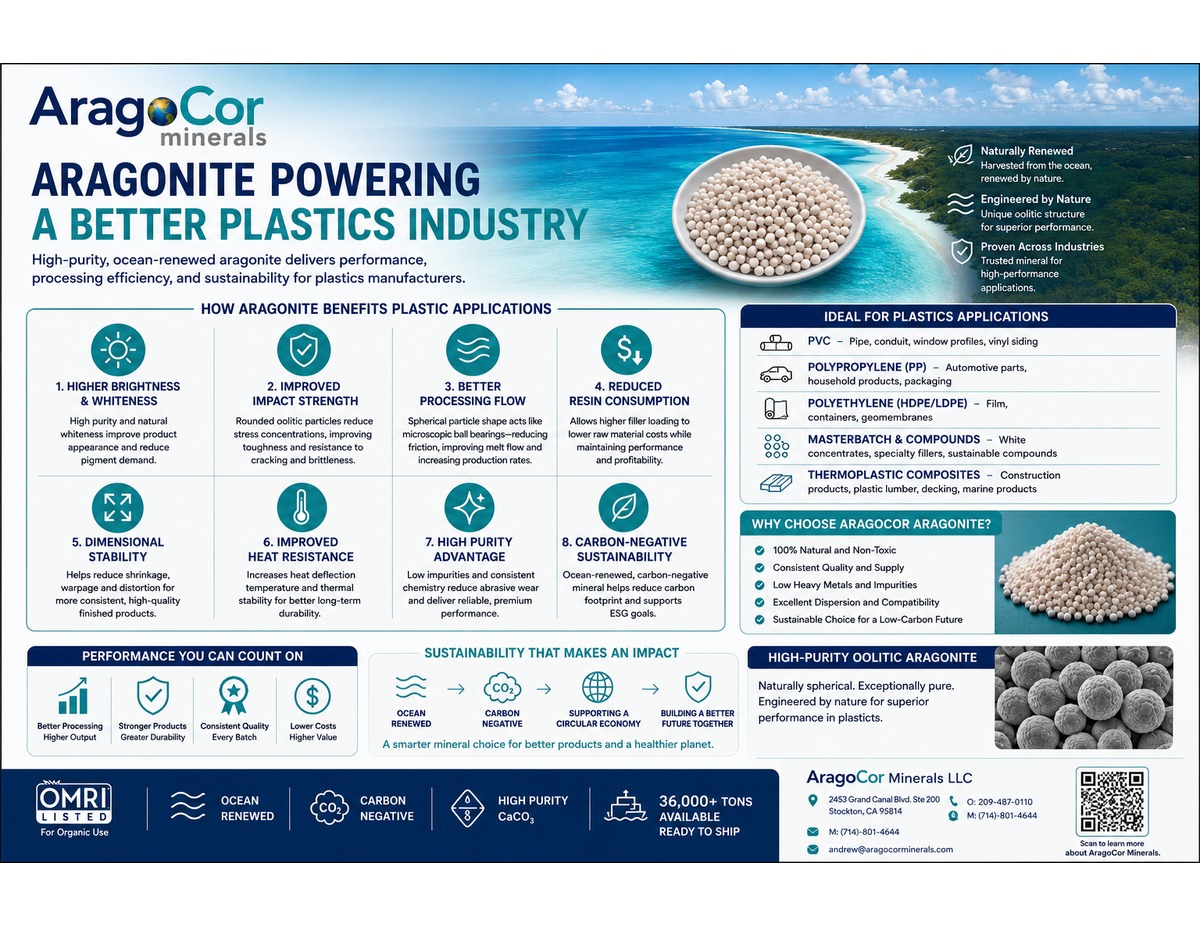
The functional-filler application
Mineral form, chemistry and distribution specified together.
Oolitic aragonite is an orthorhombic calcium-carbonate mineral ground and classified for plastics, coatings, sealants and other filled systems. Composition is 96.17% CaCO3, with particle distribution and surface treatment tailored to the formulation.
Mineral identity
Aragonite and calcite are calcium-carbonate polymorphs with different crystal systems. Formulation behavior must be established in the actual matrix.
Particle engineering
D-values, top size, fines, agglomeration and classification method affect dispersion, viscosity, surface finish and processing.
Surface area
Representative analysis gives > 1.7 m2/g.
Chemistry and appearance
Trace chemistry, moisture, color and whiteness align with finished-product requirements.
What matters to a compounder
The formulation sees the delivered powder, not the mineral name.
Application requirements, particle sizing, chemistry and handling guide product selection and use.
Particle-size targets
Define D10, D50, D90, top size, residue and agglomerate limits using the formulation and process requirement.
Moisture and handling
Set limits for moisture, bulk handling, feeding, dust collection and storage based on the production system.
Surface and compatibility
Evaluate untreated or treated-product requirements, resin or binder compatibility, dispersion energy and additive interactions.
Finished-property testing
Measure rheology, mechanical properties, opacity, gloss, surface finish and weathering as applicable to the formulation.
Application path
A practical path from specification to use.
Define the operating requirements, select the grade and measure results through the appropriate laboratory, bench or field program.
Set the target
Provide the matrix, loading, particle specification, appearance targets and process constraints.
Compound
Run controlled laboratory or pilot batches against the incumbent filler using the same processing conditions.
Produce
Transfer the selected particle profile and processing conditions into the manufacturing plan.
Material comparison
Compare the delivered material, not a generic name.
Compare chemistry, particle profile and application role across material options.
| Decision factor | Aragonite GCC | Calcitic GCC | Precipitated CaCO3 |
|---|---|---|---|
| Origin and form | Natural orthorhombic CaCO3 | Natural calcitic CaCO3 | Manufactured calcium carbonate |
| Particle profile | Ground and classified to product target | Ground and classified to product target | Process-designed; grade-specific |
| Surface area | > 1.7 m2/g | Grade-dependent | Grade-dependent |
| Substitution decision | Formulation and process testing | Formulation and process testing | Formulation and process testing |
Application design
A functional filler engineered within the complete formulation.
Particle profile, dispersion energy and additive interactions shape strength, opacity, gloss, barrier and processing performance.
Side-by-side formulation work establishes loading and processing conditions against the incumbent filler.
Where to go next
Specify a grade for this application.
Discuss a particle target and formulation program.
Send the matrix, loading, target distribution, annual volume and destination for product matching and pricing.