
Aragonite and calcite have the same chemical formula, CaCO3. They are polymorphs: the same atoms in a different arrangement. Calcite crystallizes in the trigonal system and is the form found in most limestone and chalk. Aragonite is orthorhombic, and at ordinary surface conditions it is the less stable of the two, which is why it is less common as a bulk deposit.
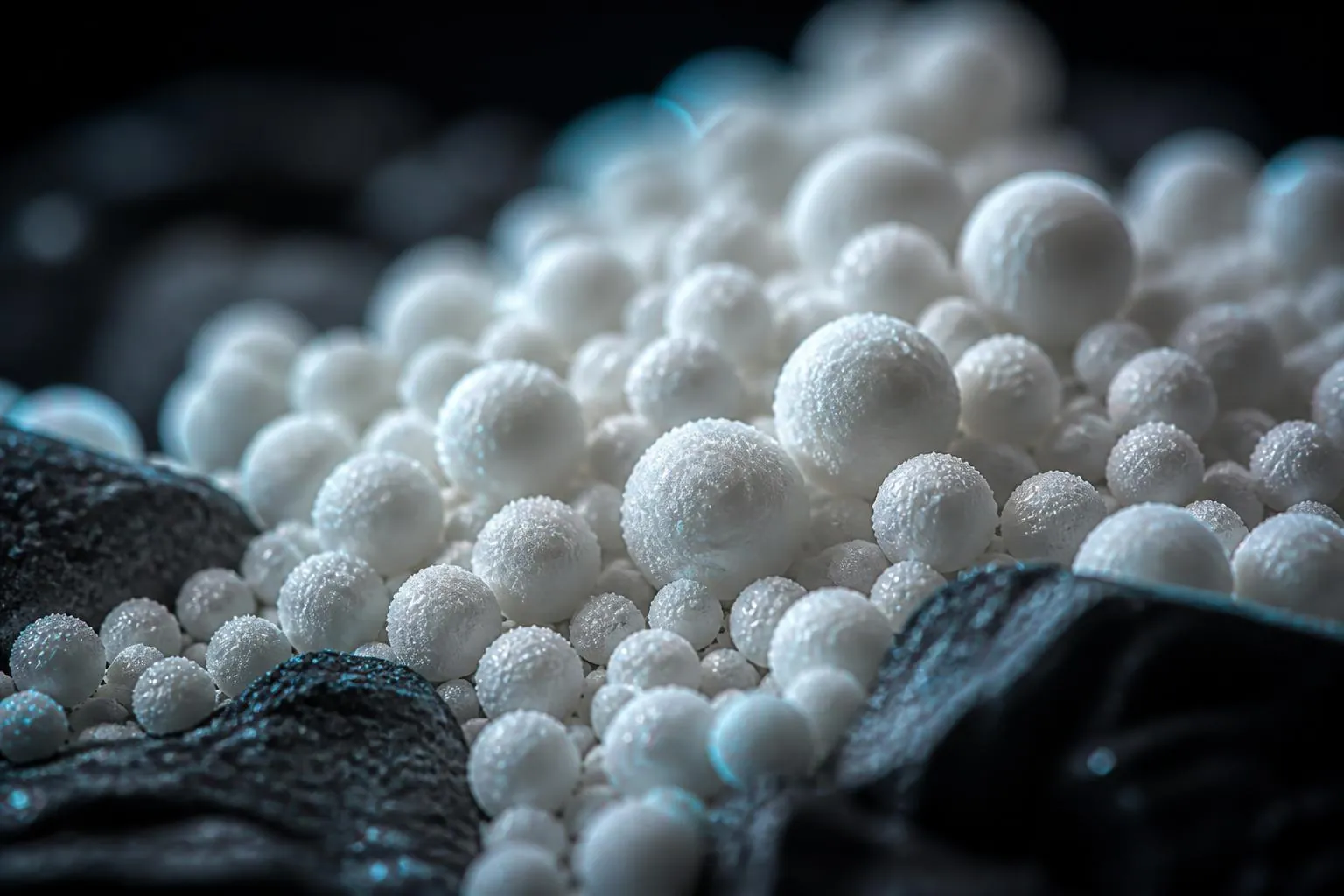
AragoCor’s material is oolitic aragonite of Bahamian marine origin: rounded, concentrically layered grains that form on the Great Bahama Bank. It is collected rather than quarried, and prepared mechanically, without a calcination step.
Where the difference shows up on paper
Solubility
Published reference solubility products at 25 °C are 6.0 × 10⁻⁹ for aragonite against 3.36 × 10⁻⁹ for calcite. Under equal conditions, aragonite is the more soluble polymorph. How much that matters in a given soil, water or process depends on that system’s chemistry, particle size and contact time, so it is something to measure there rather than assume.
Density and hardness
The AragoCor material has a representative specific gravity of 2.93 and a published Mohs hardness range of 3.5–4. Both reflect aragonite’s denser crystal packing, and both are worth knowing for handling, metering and wear in equipment.
Grain shape
Ooids are rounded by the way they form. On AragoCor material, average sphericity is 0.82 and average roundness 0.87 by API RP 56, representative analysis. Ooid grain size falls in a published range of 50–500 µm.
Behaviour on heating
Aragonite converts to calcite on heating before it decomposes. The decomposition temperature of approximately 825 °C is a published reference value for the mineral and depends on CO2 partial pressure and heating rate.
What crystal form does not tell you
Crystal structure explains why two carbonates can behave differently. It does not, by itself, establish how either will perform in a specific soil, water system, glass batch or polymer. That takes a trial in the application.
The same caution applies in reverse: a figure measured on synthetic aragonite, or on another supplier’s grade, says nothing certain about a different material. Ask for results measured on the material you would actually buy, with the laboratory and method named.
For the full side-by-side, the aragonite vs. limestone brief sets the properties out with what to test for each, and the science page covers formation and structure in more depth.
← All articles