
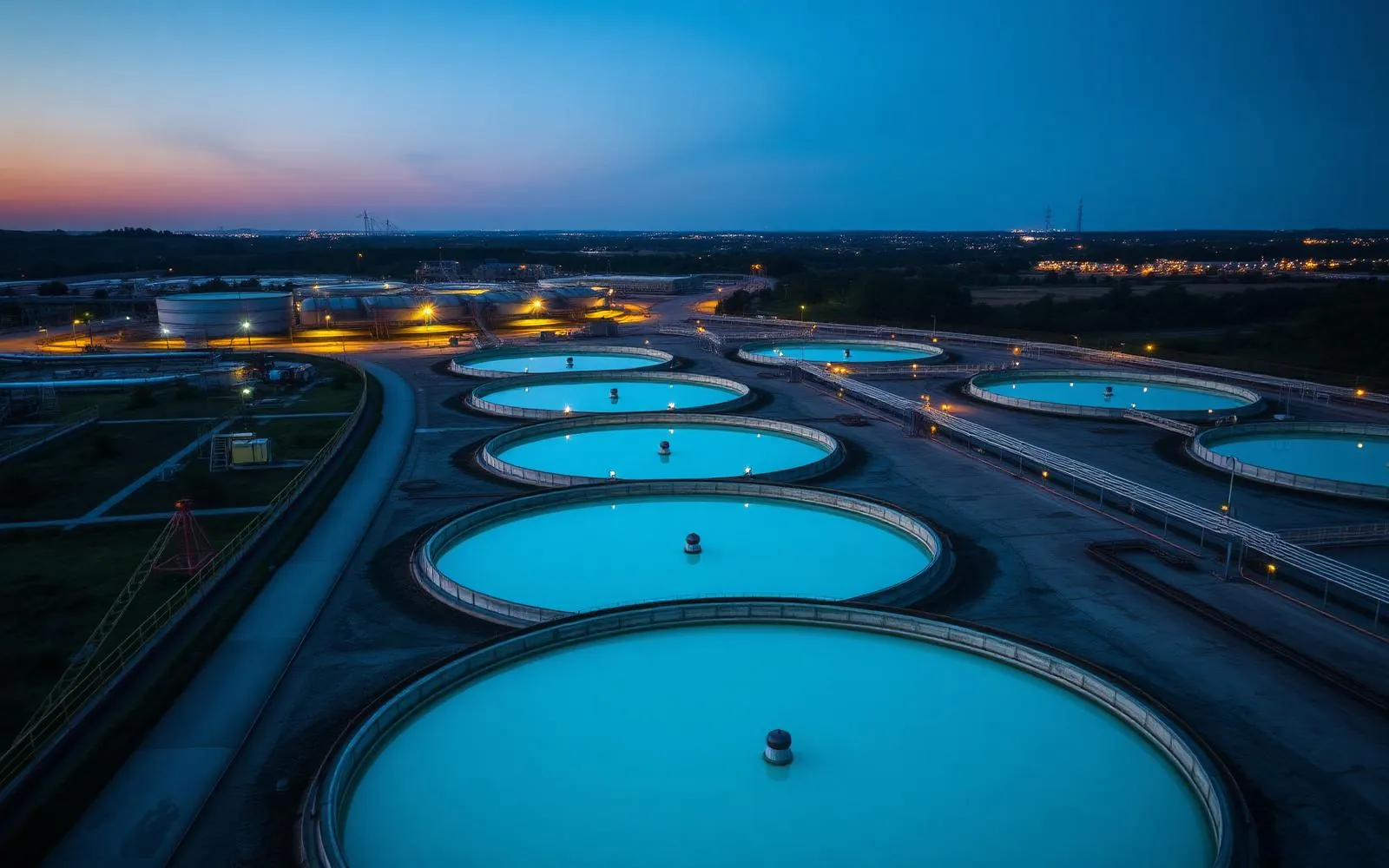
A calcium carbonate contactor is one of the simplest ways to correct aggressive water. Soft, acidic or CO2-rich water passes through a bed of granular calcium carbonate, dissolves some of it, and leaves with more calcium, more alkalinity and a higher pH. The same principle serves post-treatment after desalination and reverse osmosis, process water, aquaculture intake water and acidic well water.
How a calcium carbonate contactor works
The water’s carbon dioxide and acidity drive the dissolution. As calcium carbonate dissolves it adds calcium hardness and bicarbonate alkalinity, and the reaction slows as the water approaches equilibrium with the mineral. That is why contact time, the water’s starting chemistry and the media’s surface all matter, and why some designs dose carbon dioxide ahead of the bed to drive more dissolution.
Keep pH, alkalinity and hardness separate in the record. pH describes acidity at the moment of measurement; alkalinity is the water’s capacity to neutralize acid. The U.S. EPA’s guidance on total alkalinity explains the distinction.
Calcite and aragonite: same chemistry, different crystal
Most contactor media in service are calcite, crushed from limestone or marble. Aragonite is the same compound in a different crystal structure, and it is the more soluble of the two: published reference solubility products at 25 °C are 6.0 × 10⁻⁹ for aragonite against 3.36 × 10⁻⁹ for calcite.
In a contactor, a more soluble mineral could change how quickly the water approaches equilibrium and how fast the bed is consumed. Whether it does, and by how much, depends on the water, the flow and the grain size, and no AragoCor contactor test has measured it. Treat it as a question for a pilot, not as a performance claim.
Oolitic aragonite also differs in shape. Its grains are rounded — average sphericity 0.82 and average roundness 0.87 by API RP 56, representative analysis — where crushed media are angular. Grain shape affects how a bed packs and how it behaves in backwashing, so it belongs in the pilot record too.
What to specify for contactor media
- Grain size. A distribution with top size and fines limits that suit the vessel and its backwash. AragoCor’s WT-CAL is 1–3 mm, a published range.
- Composition. The CaCO3 content and the other constituents that will reach the treated water. AragoCor’s material is 96.17% CaCO3, representative analysis by ASTM C 25.
- Fines. How much fine material arrives with the media, which shows up as turbidity at startup. AragoCor’s representative result is 380 NTU turbidity by API RP 56, a wash-water test of fines; plan the initial flushing around it.
- Approvals. Any certification the end use requires. Drinking-water use carries product-approval requirements that composition alone does not establish; confirm them with the regulator or specifying engineer before a trial.
- Supply. The format your site can load into the vessel, and the replenishment quantity you expect.
Running a pilot
Record inlet and outlet pH, alkalinity, calcium, turbidity and head loss against flow and temperature, for long enough to cover startup, steady operation and the range the source water moves through. Compare candidate media on a consistent bed basis and log every top-up. A pilot that meets one target on one day shows far less than one that covers the water’s range.
AragoCor supplies WT-CAL for contactor remineralization, pH adjustment and filtration, documented on the water treatment media page. It makes no claim about contactor performance or drinking-water approval; the pilot and the regulator are where both are settled.
← All articles